Ontdek 9 essentiële kruidentheeën voor hormoonbalans, een combinatie van aloude wijsheid met nieuwe onderzoekspraktijken en zachte dagelijkse rituelen voor welzijn
9 Essentiële Kruidentheeën Voor Hormoonbalans

Meer mensen dan ooit zoeken naar natuurlijke manieren om de harmonie in hun lichaam te herstellen. Hormonen bepalen elke dag ongemerkt onze stemming, energie en welzijn. Wanneer ze uit balans raken, kan het leven ontwrichtend aanvoelen.
Eeuwenlang is kruidenthee voor hormoonbalans een zachte bondgenoot geweest, die zowel ritueel als subtiele ondersteuning biedt. Door traditionele wijsheid te combineren met opkomend onderzoek, kunnen we praktische manieren ontdekken om onszelf te koesteren.
Benieuwd welke kruiden echt een verschil maken? In deze gids verkennen we negen essentiële theeën om je te helpen een basis te leggen voor hormonale harmonie.
Hormoonbalans en kruidenthee begrijpen
Hormonen zijn de stille boodschappers van het lichaam, die alles orkestreren, van stemming tot metabolisme. Wanneer deze chemische signalen uit de pas lopen, rimpelen de effecten door ons welzijn. Daarom zoeken veel mensen naar zachte, natuurlijke manieren om hun hormoongezondheid te ondersteunen, inclusief het koesterende ritueel van kruidenthee voor hormoonbalans.

Wat is hormoonbalans?
Hormoonbalans is de staat waarin de hormonen van ons lichaam samenwerken in de juiste harmonie. Wanneer ze in balans zijn, voelen we ons energiek, veerkrachtig en emotioneel stabiel. Maar zelfs kleine verschuivingen kunnen leiden tot een breed scala aan symptomen, zoals vermoeidheid, stemmingswisselingen, onregelmatige cycli, slaapproblemen of veranderingen in huid en gewicht.
De meest voorkomende hormonen die worden beïnvloed, zijn oestrogeen, progesteron en cortisol, hoewel testosteron, schildklierhormonen en insuline ook belangrijke rollen spelen bij zowel mannen als vrouwen. Het is opvallend om op te merken dat ongeveer 80% van de vrouwen op een bepaald moment in hun leven hormonale symptomen ervaart. Ook mannen kunnen te maken krijgen met uitdagingen, aangezien hormoonspiegels veranderen met leeftijd en stress.
Het moderne leven maakt hormoonbalans ongrijpbaarder. Chronische stress, bewerkte voedingsmiddelen, milieutoxines en verstoorde slaap kunnen allemaal hormonen uit koers duwen. Zelfs subtiele onevenwichtigheden kunnen ons uit balans doen voelen, wat de behoefte benadrukt aan toegankelijke, alledaagse hulpmiddelen om ons endocriene systeem te koesteren.
Te midden van deze uitdagingen grijpen velen naar kruidenthee voor hormoonbalans, een eenvoudige, rustgevende manier om de natuurlijke ritmes van het lichaam te ondersteunen.
Waarom kruidenthee?
In alle culturen en eeuwenlang is kruidenthee voor hormoonbalans een vertrouwde bondgenoot geweest. Oude kruidendokters brouwden aftreksels van wortels, bladeren en bloemen om menstruatieklachten te verlichten, zenuwen te kalmeren of te verjongen na de bevalling. Deze tradities putten uit diepgaande kennis over hoe plantaardige stoffen interageren met het menselijk lichaam.
De moderne wetenschap begint nu licht te werpen op deze eeuwenoude praktijken. Veel kruiden die worden gebruikt in kruidenthee voor hormoonbalans bevatten fyto-oestrogenen, plantaardige stoffen die oestrogeen in het lichaam zachtjes nabootsen. Andere zijn adaptogenen, die het lichaam helpen zich aan te passen aan stress en de cortisolspiegels stabiel houden. Antioxidanten in kruidenthee ondersteunen de celgezondheid, terwijl mineralen en vitamines het endocriene systeem voeden.
Recente studies hebben spearmint voor PCOS, kuisboom voor PMS en brandnetel voor reproductieve gezondheid onderzocht, wat een brug slaat tussen traditie en bewijs. De dagelijkse voordelen gaan echter verder dan de biochemie. Het ritueel van het bereiden van kruidenthee voor hormoonbalans nodigt uit tot een pauze in de dag, bevordert hydratatie en stimuleert bewuste zelfzorg.
Natuurlijk is kruidenthee voor hormoonbalans geen wondermiddel. Het is het meest effectief als onderdeel van een holistische levensstijl, naast voedzaam eten, beweging en rust. Kwaliteit is belangrijk. Kies biologische, goed geproduceerde kruiden en onthoud dat sommige planten kunnen interageren met medicatie of onderliggende aandoeningen.
Op de reis naar harmonie biedt kruidenthee voor hormoonbalans zowel traditie als mogelijkheid – een zachte hand die ons terug naar het centrum leidt.
9 essentiële kruidenthee voor hormoonbalans
De juiste kruidenthee vinden voor hormoonbalans kan aanvoelen als een zacht ritueel – een daad van zelfzorg geworteld in traditie en ondersteund door een groeiend aantal onderzoeken. Hieronder verkennen we negen essentiële kruidentheeën, elk gekozen vanwege hun unieke eigenschappen en geschiedenis van gebruik ter ondersteuning van hormonaal welzijn. Of je nu op zoek bent naar comfort, energie of een gevoel van balans, deze theeën bieden een doordachte manier om jezelf elke dag te koesteren.
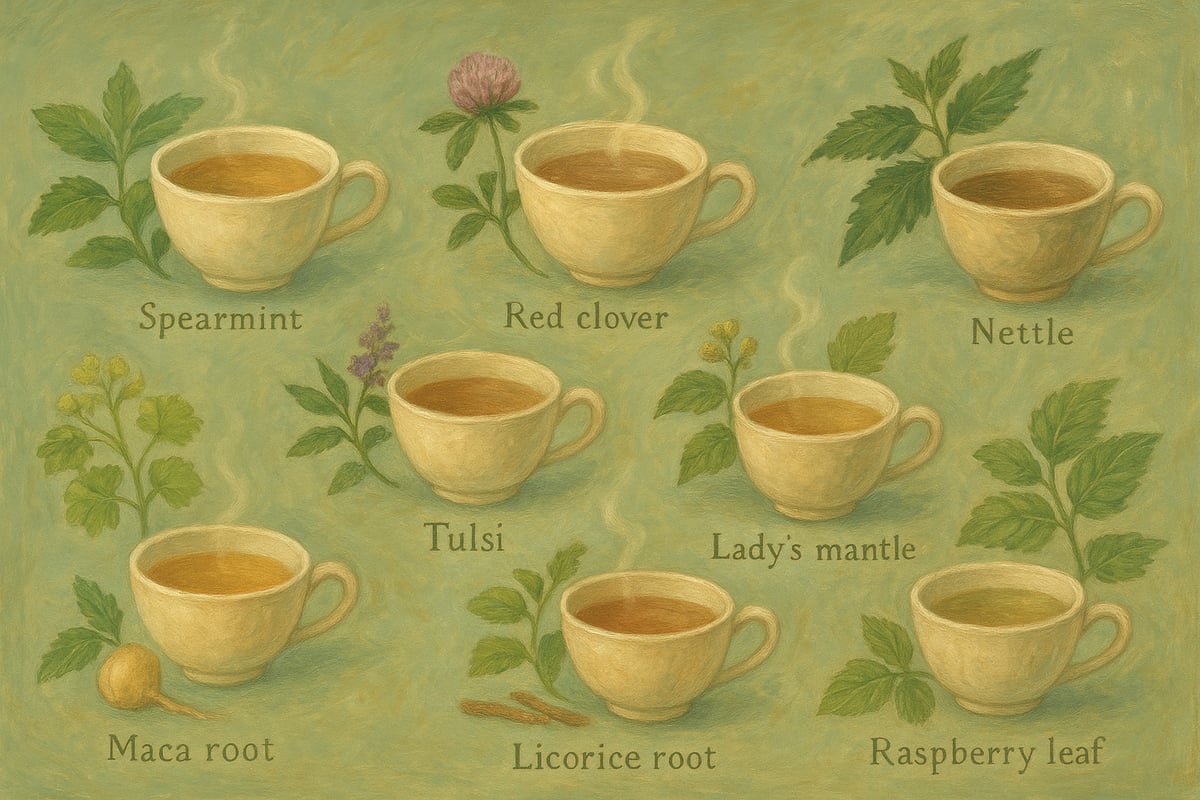
1. Spearmint thee
Spearmint thee is een gewaardeerde basis in Midden-Oosterse kruidentradities, vaak gedronken vanwege zijn verkoelende, verfrissende eigenschappen. Meer recentelijk heeft het aandacht gekregen vanwege zijn potentieel om de hormoonbalans te ondersteunen, vooral bij vrouwen met polycysteus ovariumsyndroom (PCOS).
De magie ligt in rozemarijnzuur en flavonoïden, waarvan wordt gedacht dat ze de androgeenspiegels beïnvloeden. Onderzoek suggereert dat dagelijks spearmintthee drinken kan helpen testosteron te verlagen en PCOS-symptomen te verlichten (bron).
Om ervan te genieten, laat je verse of gedroogde bladeren trekken voor een heldere, muntachtige kop; één tot twee koppen per dag is gebruikelijk. Hoewel het over het algemeen veilig is, is het verstandig om je arts te raadplegen als je zwanger bent.
2. Rode klaverthee
Rode klaverthee onderscheidt zich door zijn zachte, balancerende karakter. De delicate roze bloesems zijn rijk aan isoflavonen, natuurlijke fyto-oestrogenen die kunnen helpen bij het ondersteunen van de oestrogeenbalans.
Traditioneel wordt rode klaver gebruikt om menopauzale symptomen te verlichten en de botgezondheid te ondersteunen. Sommige studies suggereren dat het opvliegers en nachtzweten kan verminderen (bron).
Voor een voedzame kop laat je de bloemen minstens tien minuten trekken. Rode klaver kan het beste worden vermeden door mensen met hormoongevoelige kankers, maar voor velen is het een rustgevende metgezel op de reis met kruidenthee voor hormoonbalans.
3. Brandnetelthee
Brandnetelthee is een ware tonicum, geliefd om zijn diepgroene vitaliteit. Kruidendokters grijpen vaak naar brandnetel om de bijnierfunctie, reproductieve gezondheid en energieniveaus te ondersteunen.
Brandnetel, boordevol ijzer en magnesium, kan bijzonder nuttig zijn voor mensen die last hebben van PMS, zware menstruaties of vermoeidheid. Vroege studies wijzen op de ontstekingsremmende en antioxiderende kwaliteiten (bron).
Een dagelijkse kop is zowel voedzaam als aardend. Brandnetel combineert prachtig met andere kruiden. Voor een diepgaande blik op de voordelen voor hormonale en reproductieve gezondheid, verken Brandnetelthee Voordelen.
Controleer, net als bij elke kruidenthee voor hormoonbalans, op interacties als u bloedverdunners gebruikt.
4. Kuisboom (Vitex) thee
Kuisboom, of Vitex, heeft een lange traditie in de Europese kruidengeneeskunde voor het ondersteunen van menstruatiecomfort en -regelmaat. De kleine paarse bessen werken zachtjes in op de hypofyse en helpen gezonde progesteronniveaus te ondersteunen.
Modern onderzoek ondersteunt het gebruik ervan voor het verlichten van PMS- en PMDD-symptomen (bron). De bessen hebben een langere trektijd of zelfs een zachte suddering nodig om hun goedheid vrij te geven.
Een kop kuisboomthee, regelmatig gedronken, kan een aardend ritueel worden voor mensen die kruidenthee voor hormoonbalans zoeken. Vermijd het tijdens de zwangerschap en controleer op mogelijke interacties met medicatie.
5. Tulsi (heilige basilicum) thee
Tulsi, of heilige basilicum, wordt in de Ayurveda vereerd als een adaptogeen dat veerkracht en kalmte brengt. De aromatische bladeren bevatten eugenol en ursolinezuur, waarvan wordt aangenomen dat ze stresshormonen zoals cortisol helpen moduleren.
Vroeg onderzoek suggereert dat tulsi de stemming kan ondersteunen en de effecten van dagelijkse stress kan verlichten (bron). Veel mensen drinken tulsi-thee 's ochtends of 's middags en vinden het zowel rustgevend als opbeurend.
Als u kruidenthee voor hormoonbalans gebruikt, wordt tulsi over het algemeen als veilig beschouwd, hoewel het verstandig is om uw arts te raadplegen als u medicatie gebruikt.
6. Vrouwenmantelthee
Vrouwenmantel is een zacht, wijze-vrouwenkruid, al lang gevierd in Europese volkstradities voor het ondersteunen van menstruatiecomfort en cyclusregelmaat. De samentrekkende werking wordt geacht de baarmoeder te versterken en te kalmeren.
Hoewel menselijk onderzoek beperkt is, spreekt de geschiedenis van het kruid boekdelen, en kruidendokters combineren het vaak met frambozenblad voor extra ondersteuning. Vermijd tijdens de zwangerschap, tenzij onder begeleiding van een professional.
7. Macawortelthee
Macawortel, afkomstig uit de Andes, staat bekend om zijn aardse smaak en reputatie als vitaliteitsbooster. Maca, rijk aan plantensterolen en macamides, wordt gebruikt ter ondersteuning van energie, libido en hormonale veerkracht.
Sommige bewijzen suggereren dat het de stemming en het libido tijdens de menopauze kan verbeteren (bron). Maca kan als thee worden gedronken of worden gemengd in warme dranken met cacao voor een voedzame traktatie.
Zoals bij elke kruidenthee voor hormoonbalans is matigheid essentieel – hoge doses kunnen bij gevoelige personen spijsverteringsklachten veroorzaken.
8. Zoethoutwortelthee
Zoethoutwortelthee is een basisproduct in de traditionele Chinese geneeskunde, vaak gekozen voor bijnierondersteuning en zijn zoete, aardse smaak. De belangrijkste actieve stof, glycyrrhizine, wordt verondersteld cortisol en andere stresshormonen te helpen moduleren.
Sommige studies benadrukken het potentieel voor het ondersteunen van de hormoonbalans (bron), hoewel voorzichtigheid geboden is (bron). Zoethout moet spaarzaam worden gebruikt en niet dagelijks voor langdurig gebruik.
Als u kruidenthee voor hormoonbalans gebruikt, vermijd dan zoethout als u een hoge bloeddruk heeft of tijdens de zwangerschap.
9. Frambozenbladthee
Frambozenbladthee is een klassieke bondgenoot voor de gezondheid van vrouwen, gekoesterd vanwege zijn zachte ondersteuning van de baarmoeder en de menstruatiecyclus. De bladeren zijn rijk aan fragrine, een unieke alkaloïde, samen met vitamines en mineralen.
Traditioneel wordt frambozenblad gebruikt om krampen te verlichten en de bevalling te ondersteunen, en sommige onderzoeken ondersteunen de voordelen ervan (bron). Geniet dagelijks van één tot drie koppen, vaak gemengd met andere ondersteunende kruiden.
Als u kruidenthee voor hormoonbalans gebruikt tijdens de zwangerschap, raadpleeg dan een professional om er zeker van te zijn dat het geschikt is voor u.
Dagelijkse rituelen en blendideeën voor hormonale harmonie
Het creëren van een dagelijks ritueel met kruidenthee voor hormoonbalans kan een eenvoudige kop transformeren in een aardende daad van zelfzorg. Consistentie en intentie vormen de kern van deze praktijk. Wanneer je pauzeert, je kruiden kiest en bewust brouwt, nodig je rust en focus uit in je dag.
Stel je voor dat je je ochtend begint met een zachte blend van spearmint en brandnetel. Deze combinatie wordt al lang door kruidendokters gebruikt om energie en hormonale harmonie te ondersteunen. Zoek een rustige plek, adem de aroma's in en laat elke slok een moment van verbinding met jezelf zijn. Na verloop van tijd kunnen deze kleine rituelen je helpen om je te aarden, waardoor de voordelen van kruidenthee voor hormoonbalans deel gaan uitmaken van je natuurlijke ritme.

Een thee-ritueel opbouwen
Om je kruidenthee voor hormoonbalans praktijk te verdiepen, is consistentie essentieel. Probeer een vaste tijd in te plannen, of het nu een rustige ochtend is of een ontspannende avond. Creëer een ruimte die uitnodigend aanvoelt – misschien met een favoriete mok, zachte verlichting of een vleugje natuur in de buurt.
Hier is hoe je zou kunnen beginnen:
- Kies 1-2 kruiden met jouw intentie in gedachten
- Kook vers water en doseer je kruiden zorgvuldig
- Laat trekken, inhaleer en geniet van het moment
Blenden is een andere manier om je ervaring te personaliseren. Zo kan een kop frambozenblad met brandnetel een voedzaam ritueel zijn voor cyclusondersteuning, zoals beschreven in Frambozenblad en Vrouwelijkheid. Door te observeren hoe elke blend aanvoelt in je lichaam, kun je na verloop van tijd aanpassingen doen voor een diepere ondersteuning.
Uw mix aanpassen
Met kruidenthee voor hormoonbalans bent u vrij om uw blends af te stemmen op uw unieke behoeften. Het combineren van kruiden kan synergie creëren – tulsi en rode klaver voor stress en menopauze, of brandnetel met vrouwenmantel voor cycluscomfort.
Smaak doet er ook toe. Als je een kruid te sterk vindt, verzacht het dan met een zachtere partner. Zie je blend als een seizoensrecept, dat meebeweegt met de ritmes van je lichaam. Voor degenen die nieuwsgierig zijn naar vrouwenmantel, de zachte samentrekkende werking combineert prachtig met frambozenblad.
Het bijhouden van je cyclus of het noteren hoe je je voelt na elke blend kan je helpen je keuzes te verfijnen. Na verloop van tijd wordt je kruidenthee voor hormoonbalans een levendig gesprek tussen jou en je welzijn.
Veiligheid, inkoop en duurzaamheid
Kwaliteit en zorg zijn essentieel bij het kiezen van kruidenthee voor hormoonbalans. Zoek altijd naar biologische of wild geplukte kruiden van gerenommeerde bronnen, en controleer op versheid en ethische oogstmethoden.
Houd rekening met persoonlijke gevoeligheden of gezondheidsproblemen. Sommige kruiden zijn niet geschikt voor bepaalde personen, dus luister naar uw lichaam en raadpleeg indien nodig een gekwalificeerde kruidkundige of zorgverlener. Duurzaamheid is ook belangrijk – steun telers die prioriteit geven aan de aarde en eerlijke handel.
Door intentie, kennis en respect voor de natuur te verweven in uw kruidenthee voor hormoonbalans, voedt u niet alleen uw hormonen, maar uw hele zelf.
Kruidenthee voor hormoonbalans
De wereld van kruidenthee voor hormoonbalans evolueert snel, waarbij voorouderlijke kruidenwijsheid wordt gecombineerd met moderne innovatie. Terwijl we 2026 ingaan, wenden steeds meer mensen zich tot zachte, plantaardige rituelen voor ondersteuning, wat nieuwe trends en opwindend onderzoek aanwakkert. Wat zal het volgende hoofdstuk van deze oude traditie vormen?

Opkomend onderzoek en bewijs
Nieuwe studies werpen licht op hoe kruidenthee voor hormoonbalans het welzijn kan ondersteunen. Adaptogenen en fyto-oestrogenen krijgen speciale aandacht, aangezien onderzoekers onderzoeken hoe deze plantenstoffen het lichaam helpen zich aan te passen aan dagelijkse stress en hormonale verschuivingen.
Recente systematische reviews hebben bijvoorbeeld de effecten van kruidenthee op vrouwen met PCOS geanalyseerd, waarbij bemoedigende veranderingen in metabole en hormoonmarkers werden onthuld (Systematische review over kruidenthee en PCOS). Naarmate de wetenschap de traditie inhaalt, krijgen we een duidelijker beeld van welke kruiden de meeste ondersteuning kunnen bieden.
Personalisatie, technologie en kwaliteit
Een van de meest opwindende trends is de opkomst van gepersonaliseerde blends. Met technologie-ondersteunde abonnementen kunt u nu kruidenthee ontvangen voor hormoonbalans, afgestemd op uw cyclus, stressniveaus of zelfs uw genetisch profiel. Deze persoonlijke touch brengt kruidenwijsheid rechtstreeks bij u thuis.
Transparantie en kwaliteit staan ook in de schijnwerpers. Welzijnszoekers stellen meer vragen over inkoop, duurzaamheid en zuiverheid. Velen wenden zich tot deskundige bronnen zoals Healthline: Kruiden die hormonen in balans brengen om hun keuzes te begeleiden, zodat hun kruidenthee voor hormoonbalans zowel effectief als verantwoord wordt gemaakt.
Gemeenschap, onderwijs en empowerment
Kruidenrituelen vinden hun weg naar mainstream wellness-ruimtes, ondersteund door een bloeiende gemeenschap van kruidendokters, docenten en liefhebbers. Workshops, online forums en lokale bijeenkomsten maken het gemakkelijker dan ooit om samen te leren, te delen en te groeien.
Op de hoogte blijven is essentieel. Zoek naar betrouwbare studies, neem contact op met gekwalificeerde kruidendokters en sluit u aan bij gemeenschappen die zowel traditie als wetenschap waarderen. Door onderwijs en intentie in uw dagelijkse kop te verweven, helpt u de toekomst van kruidenthee voor hormoonbalans vorm te geven – slokje voor slokje.
Na het verkennen van deze negen eeuwenoude kruidentheeën en de zachte rituelen die de hormonale harmonie kunnen ondersteunen, is het duidelijk dat er zoveel plantenwijsheid op ons wacht in elke kop. Of u nu nieuwsgierig bent naar het mengen van uw eigen theeën of meer intentie wilt toevoegen aan uw dagelijkse routine, u hoeft het niet alleen te doen. Als u klaar bent om uw reis met kruiden te verdiepen en blends te ontdekken die speciaal zijn gemaakt voor hormonale balans en het welzijn van vrouwen, nodig ik u uit om onze collectie Vrouwenwelzijn te ontdekken, gemaakt om de balans en cyclus van vrouwen te ondersteunen.